At WAIC 2026 in Shanghai, real-world applications of embodied intelligence emerged as a major focus. As the critical end effector that enables robots to interact with the physical world, dexterous hands are becoming an essential capability for advancing humanoid robots toward real-world deployment.
During the event, DH-Robotics’ UDH-3-7 three-finger dexterous hand was featured in CCTV News coverage and integrated with seven Geek+ general-purpose humanoid robots. Together, they completed warehouse logistics tasks, including tote handling and the sorting of bananas, plush toys, towels, packaged bread, and snack bags.
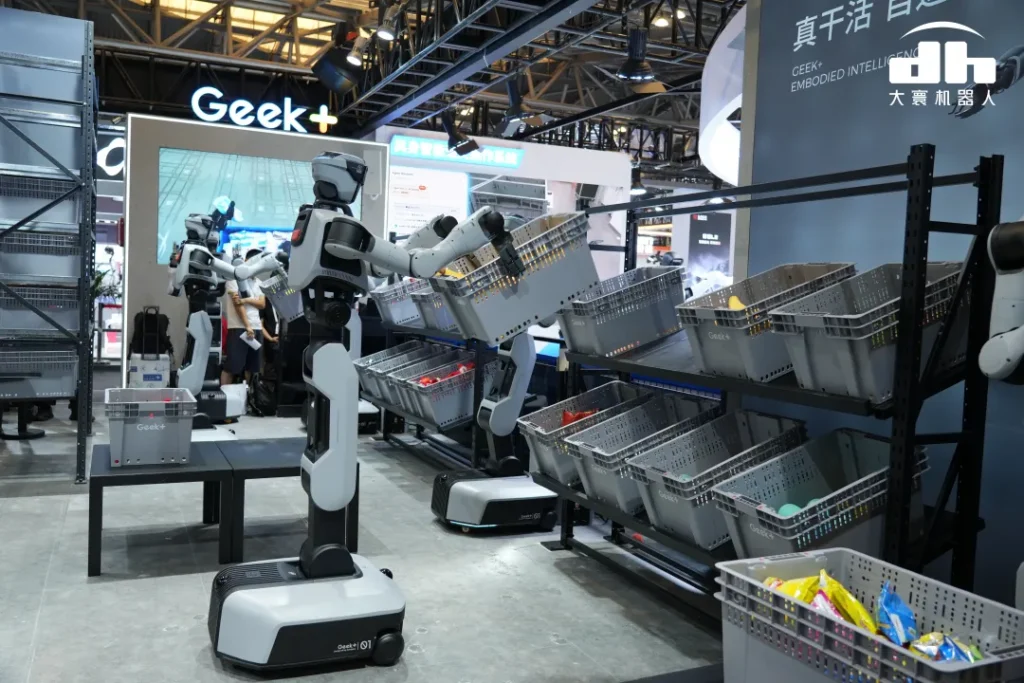
Stable Tote Handling for Warehouse Logistics
Warehouse tote handling places demanding requirements on a robot’s end effector. When handling materials with significant weight, a dexterous hand must provide sufficient load capacity while maintaining stable and reliable grasping throughout continuous operation.
The UDH-3-7 weighs just 900 g, delivers up to 50 N of fingertip force, and supports a maximum lifting payload of 15 kg. This lightweight design combines high gripping strength with the stability required for real-world warehouse logistics.
Compared with two-finger grippers designed for standardized grasping tasks, the three-finger dexterous hand provides greater flexibility for complex handling operations. Two-finger grippers typically rely on either enveloping or parallel gripping. Enveloping designs can accommodate a certain range of object geometries but may have limitations under high payload. Parallel designs often require object-matched fingertips and provide less flexibility when adjusting the grasp posture.During the tote-handling demonstration, the index and middle fingers provided the primary lifting support while the thumb locked the tote from the side. This coordinated grasp formed a stable configuration that more closely reflects how a human hand carries a container.
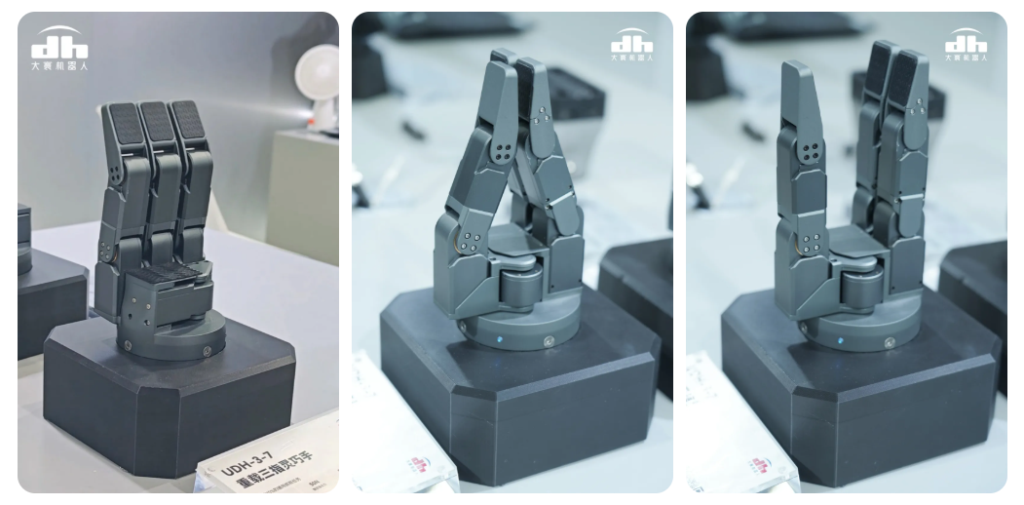
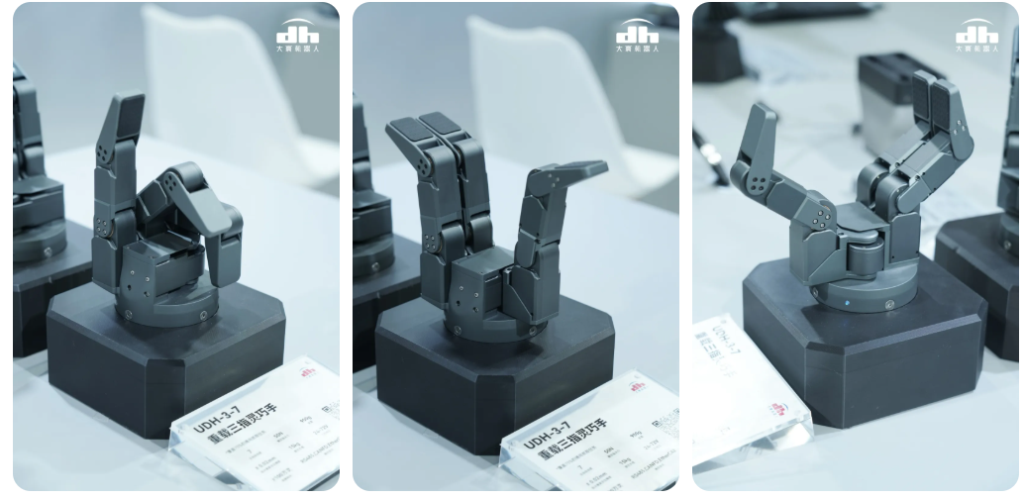
Seven Degrees of Freedom for Flexible Grasping
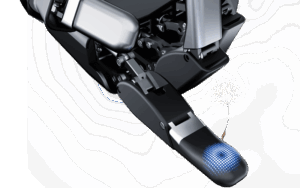
The UDH-3-7 features seven active degrees of freedom: three in the thumb and two each in the index and middle fingers. This configuration enables more flexible finger control, independent drive, and coordinated motion across all three fingers.
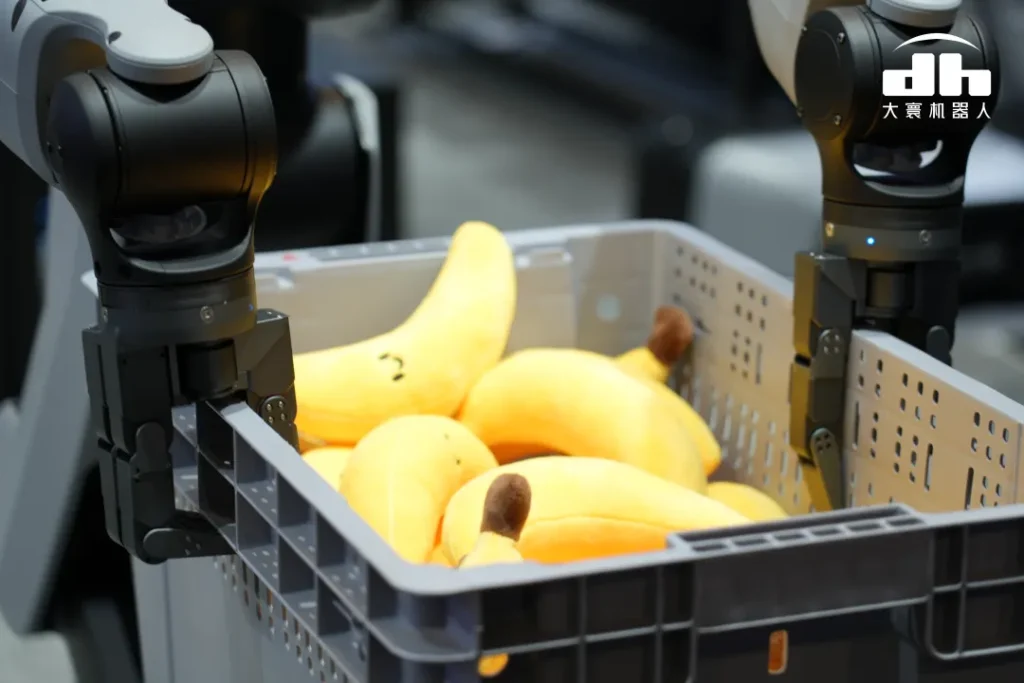
Rather than relying on a fixed grasp pose, the three-finger dexterous hand can dynamically adjust its grasping strategy according to the shape, material, and weight of different objects. This capability helps improve a robot’s generalized grasping performance in complex and changing environments.The thumb supports a 180-degree swing. It can oppose the index and middle fingers for a centered grasp or switch to a coordinated side-by-side mode, enabling a broader range of grasp configurations.
Sorting Irregular Items in Unstructured Environments
Unlike standardized industrial production lines, real warehouse logistics environments contain objects with different shapes, materials, and weights. These variations create significant challenges for robot grasping and manipulation.
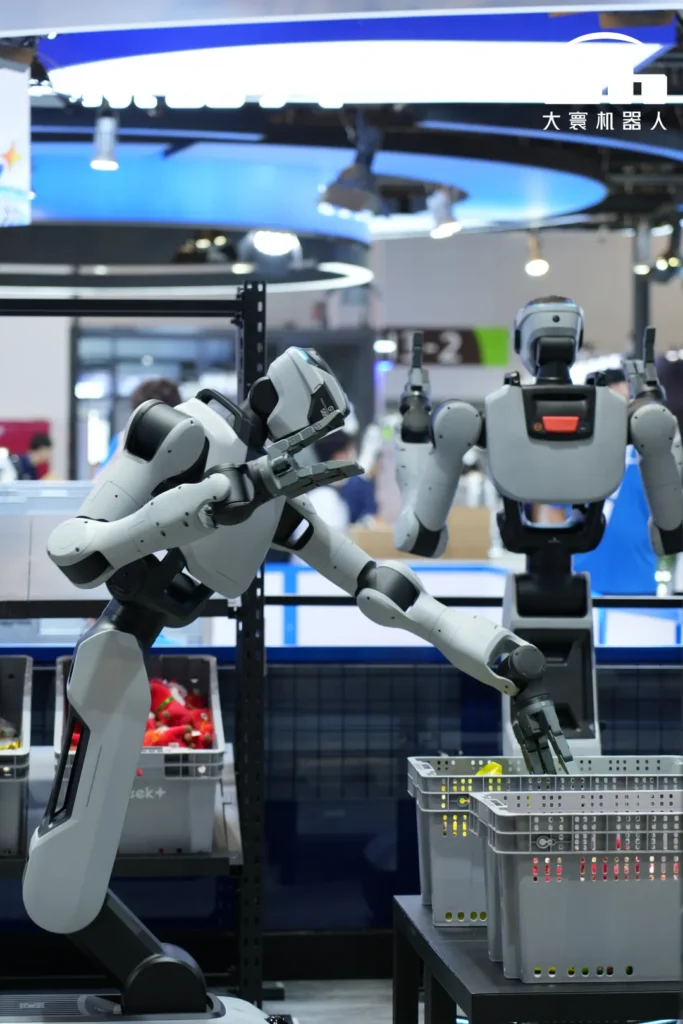
At WAIC 2026, the UDH-3-7 completed live sorting demonstrations involving bananas, plush toys, towels, packaged bread, and snack bags. Its multi-finger coordination enabled the robot to adjust the grasp pose to suit different objects, demonstrating the adaptability of dexterous manipulation in unstructured warehouse environments.
These capabilities are important for humanoid robots moving beyond controlled demonstrations and into practical applications that require flexible interaction with diverse objects.
Dexterous End Effectors Expand Robot Application Boundaries
As embodied intelligence moves from technical exploration toward real-world deployment, robots are operating in more open and complex environments. The end effector serves as the key interface between a robot and the physical world, and its performance directly affects the boundaries of robot applications.The WAIC 2026 task validation of the UDH-3-7 in warehouse logistics demonstrated the application potential of three-finger dexterous hands for complex physical interaction. Stable grasping, flexible finger control, and dynamic manipulation strategies can help humanoid robots perform a wider range of practical tasks.
DH-Robotics’ End-Effector Solutions for Embodied Intelligence
DH-Robotics will continue advancing dexterous manipulation technologies and expanding its end-effector solutions from two-finger to three- and five-finger dexterous hands.Through continued innovation in motion control, force control, and intelligent end-effectors, DH-Robotics is working to make dexterous manipulation a practical foundation for embodied intelligence at scale.Learn more about the UDH-3-7 three-finger dexterous hand and contact DH-Robotics to discuss end-effector solutions for humanoid robotics, warehouse automation, and embodied intelligence.